
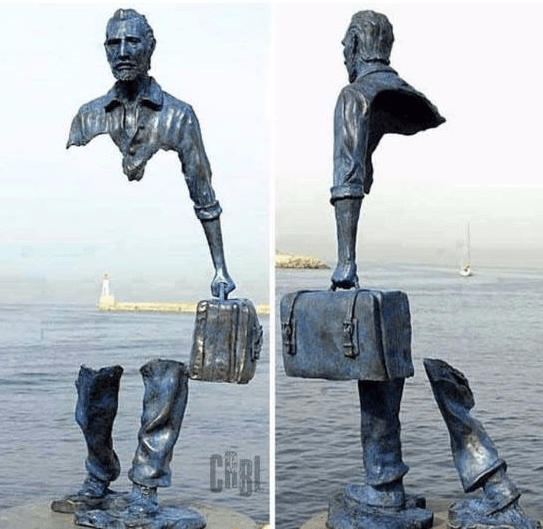
It’s said that this picture illustrates the emptiness a person feels when leaving his/her country.
The subject of working abroad parents and of thousands of children raised by grandparents, ants and uncles or other relatives seems to be one of the most painful subject to address. This experience is unique for each person touched by it. It comes with a lot of vulnerability, either acknowledged or not by those impacted by this phenomena. For me personally, someone who has emerged from a society where every second family has at least one parent working abroad, and who has been impacted both directly and indirectly by this, it is quite hard to discuss the repercussions with friends, family, brothers/sisters, etc. Its almost impossible to address the impact of the absence of crucial people throughout my upbringing in open conversations, but I hope that writing this post will ignite some sort of discussion, no matter how uncomfortable that might be.
So, why does it feel so hard to reflect upon it? Well, that would be because talking about it, even now writing about it means actually feeling pain, which hasn’t been recognized or internalized until now, as well guilt. The guilt comes along simply because, regardless of how hard it might have been for me, I know that for my parents and relatives who actually had to go work abroad it was thousands times harder. I happened to experience this side of story by myself, having been studying and working abroad for more than five years, during which I have realized how wrong are the myths of “the beautiful life abroad” we told ourselves while growing up in Moldova. Facing this guilt and pain, I still want to unleash at least some ideas about this experience, even if tomorrow I’ll feel like deleting it all.
Throughout childhood and adolescence, seeing how my closest family was spreading out in different corners of the world, I experienced more or less the following:
- Injustice
- Distrust in people
- False maturity
- Hatred towards the economical and political system from Moldova
Injustice
I remember the first moment I have felt that so clearly like it was yesterday. It’s a memory of mine that I haven’t shared with anyone until now. I was eight years old and we were with my family at my cousin’s birthday. She was turning nine years old and her mom had left for a job abroad a few months prior to that. There was a congratulation for her, either on radio or TV, arranged so it would come from her mother since she couldn’t be there. I hope you can imagine how much emotion such a surprise congratulation brings out in a nine-year old child. How can anyone justify to a child the absence of her mom in a day like this? Sitting there in my father’s arms, in the presence of both my mom and dad, I couldn’t help but think about how unfair it was that I had my mom nearby and it wasn’t even my birthday, while my cousin was in such pain on what should normally be a joyful birthday.
Distrust in people
The mistrust in other people, but also in myself, appeared because so many of those people whom I loved unconditionally because they were ants, uncles, cousins, crucial members of our community were leaving. Just like that, one day they were there and the next day they were leaving. And, in a spin of one to three months the whole world was shifting upside down. The birthdays, holidays or just random visits that we regularly have had, became Skype meetings which, throughout years, were rarer and rarer. It could be something I felt due to my high sensibility, but seriously, seeing sad parents because of the absence of their children and grandchildren or brothers and sisters raised without the unconditional presence of their parents is something touching to a certain extent.
False maturity
False maturity appeared because, when someone dear from the family is leaving, the tendency is to replace that person so that the family can go on functioning more or less as whole. In such cases, the boy becomes the head of the family even at 12 years old, the big sister steps in to be a sort of mother to her younger siblings already at 14 years old, the dad becomes a second mother, the mother magically becomes both parents at the same time, etc. And, for a while, everybody feels like things are working out and they are learning cooking and cleaning, assuming bigger responsibilities and becoming adults way ahead of time. But the truth is that, what remains behind, are people who haven’t been hugged enough, children with no proper childhood and teenagers with no proper adolescence phase, shoulders on which no one cried on, untold words, unshed tears, bicycle rides which no one taught those kids, unbraided hair and many more.
Hatred towards the economical and political system of Moldova
The hatred towards the economical and political system from Moldova has been developing as well throughout years. However, during the last couple of years, that hatred reshaped itself into pride and love. But, I did experience a lot of sadness related to Moldova before reaching today’s state of joy when saying: “I am from Moldova”. I cannot justify nor explain these feelings of anger and hatred, it’s stupid and it was the opposite of everything I was taught in school: Love your country and honor it at all times. What I was thinking to myself was: What is there to love? Nothing, all I want is to leave as well like everybody else dear to me is doing. This genuine desire of leaving Moldova has appeared at about 13 years old and, despite some failed tentatives in doing so throughout high-school years, I finally graduated and left for university in Denmark after 6 years. What is more, at 21 years old I was already at a summer job in USA and all my mind was doing throughout most of the working day was to remember some dear songs of Moldovan artists which I listened to while growing up. Songs which I haven’t heard in years were pouring down with memories, tears and longing after Moldova. I had realized back then this dilemma I had in my head: on one side – a lot of love for the home country, on the other side – feeling vindictive and clinging to so much negativity about all it deprived me of while growing up. It was time to start letting go of hatred and anger and letting in the love and pride towards my family, community and the country where I was from. It’s a beautiful journey. Of course, I don’t know what the end destination will feel like, but I do know that today I have a much healthier perspective on this whole idea of dear people working abroad and the family being spread on multiple continents.
In conclusion…
To me, the fact that I can write about this quite sensitive subject means that I have already dealt with all the resentments and feelings of distress related to it. I admit that overcoming this “pain” did take approx. three years, so it’s not an easy task, but it’s definitely a beneficial one in the long run. One of the things that I did were the meditations/prayers of forgiveness. I think that both those who couldn’t be there for their growing children, or those who couldn’t be there for their aging parents should simply make peace with it and forgive themselves. One exercise that I recommend is the ho’oponopono practice, which essentially consists of saying these sentences in a quite meditation towards a specific person: Forgive me, I love you, Thank you, while breathing profoundly and calmly.
May all of you have a peaceful day!
Traducerea în Română e disponibilă aici.
 ACVILS' personal blog
4 thoughts on “Growing up with parents working abroad”